
Planter windbreak glass systems are not limited to a single standard product; different model families emerge as frame height, portability, lighting, and glass form vary. To select the right model, it's necessary to first determine the wind load of the area, and then the frequency of use.
Model Families of Windbreak Glass Systems for Potted Plants
Standard potted model
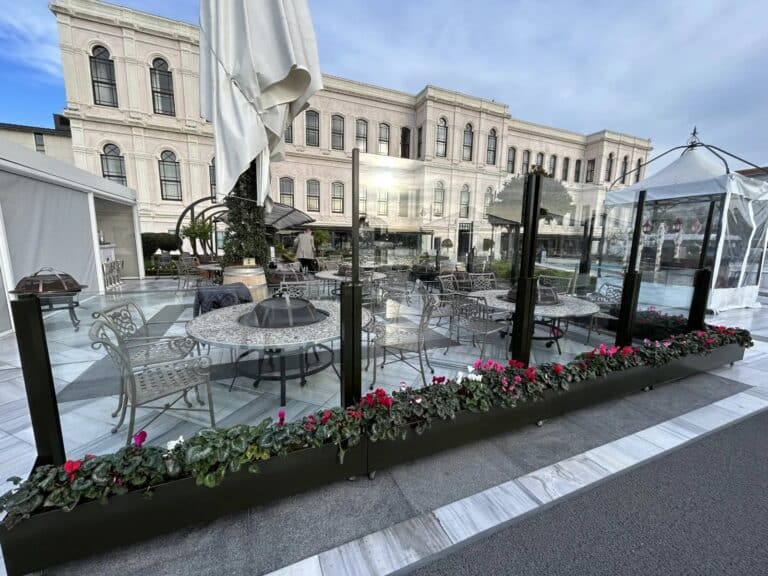
This is the most common type. It has a body height of 40-45 cm, with a glass panel on top measuring 70-90 cm. The total height is between 115-135 cm, reaching just above the head height of a seated person. It is the preferred solution for cafe terraces where sidewalk width is limited.
Tall potted model
The trunk reaches a height of 55-60 cm. Larger plants can be planted thanks to the deeper soil volume, and wind resistance increases due to the increased module weight. Suitable for seaside areas and open terraces.
wheeled model
Braked wheels are mounted under the body. The unit can be positioned by pushing it with one person; businesses that need to open service access or collect units at closing time choose this model. When the brake is locked, the unit remains stationary.

Oval and corner models
The rounded body shape reduces the risk of collisions in narrow passages. Corner modules offer 90 and 135-degree connections, creating a seamless line on L- or U-shaped terraces.
LED illuminated model
The LED strip, concealed along the top edge of the planter's stem, makes the barrier visible in the evening while also providing atmospheric lighting. It operates with a 12V transformer and requires an IP65 rating for outdoor use.
Practical Rules Instead of Size Charts
In practice, the size selection can be reduced to three numbers. The module width remains in the range of 100-150 cm, the total height in the range of 110-160 cm, and the pot depth in the range of 25-40 cm. As the width increases, the glass thickness should also increase: 8 mm for panels under 120 cm, and 10 mm for those above. Tempered glass is preferred.. When the height exceeds 160 cm, it is no longer considered a portable unit, and anchoring to the ground becomes mandatory.

Glass Options for Windbreak Glass Systems for Potted Plants
Which Business Should Choose Which Model?
For street cafes with high pedestrian traffic, wheeled units of standard height are sufficient. Restaurants along the coast require models with tall planters and 10 mm glass. Around hotel pools, oval-shaped models stand out for both safety and aesthetics. In shopping mall inner courtyards, glassless or low-glass units are used to define boundaries without dividing the space.
You can review the relevant system pages: windbreak glass systems, windbreak glass systems.
Assembly and Delivery Time
Once the model selection is finalized, the production time is approximately 10-15 business days. LED and custom color requests may extend this time by a few days. Assembly is completed within half a day to one business day, depending on the number of modules. If the floor is not reinforced concrete or is a wooden deck, the type of footplate must be determined in advance.
It is recommended to check the bolt tightness during the first season after delivery. When aluminum and glass work together, minimal seating occurs in the gaskets due to thermal expansion differences; this is normal and can be resolved with a one-time adjustment.
Comparison of Planter Windbreak Glass Systems and Classic Barriers
There are three main methods used to enclose outdoor space: wooden panels, canvas screens, and glass barriers. While wooden panels have a low initial investment cost, they require sanding and varnishing every season and swell when exposed to moisture. Canvas screens create a sail effect in the wind, tear at the seams, and fade in color within a few years. Glass solutions, on the other hand, maintain their appearance for many years without requiring maintenance.
The difference between glass-enclosed barriers and those with potted plants is that they not only define a boundary but also add a green touch to the space. This eliminates the need for businesses to purchase additional pots and plant stands. Visually, the barrier is perceived not as an obstacle but as a landscape element. From a customer experience perspective, this difference directly impacts the likelihood of the terrace being chosen.
Common Mistakes in Installing Windbreak Glass Systems for Potted Plants
Maintenance Schedule for Windbreak Glass Systems for Potted Plants
In spring, plant replacement and soil replenishment are carried out, and bolt tightness is checked. During the summer, the glass surface is wiped every two weeks. In autumn, drainage holes are drilled and leaf litter is removed. If wheeled units are to be stored in the warehouse at the start of winter, the glass panels should be disassembled and stacked separately; the glass panels should be stored at a slight angle, not vertically, with a foam interlayer in between.
Price and Offer
Pricing is calculated based on body height, glass thickness, LED options, and total linear meterage. The cost per module decreases as the quantity increases. For current price ranges: price lists. To share your measurements and receive modulation suggestions: communication. You can review the relevant system page: cafe and restaurant garden enclosure systems.
Brief Assessment
Model selection becomes clear at the intersection of the area's wind load and usage routine. Within planted windbreak glass systems, there are five basic families: standard, high-bodied, wheeled, oval, and illuminated. Dimensions and glass thickness are determined based on this preference.




 Türkçe
 English
 Français
 Deutsch
 العربية
 Español
 فارسی
فارسی Afrikaans
 Italiano
 日本語
日本語 Bahasa Indonesia
 简体中文
简体中文 Українська
 Svenska
 Shqip
Shqip Русский
 Português
 Română
 한국어
한국어 Azərbaycan dili
 Polski
 Български
 Српски језик