
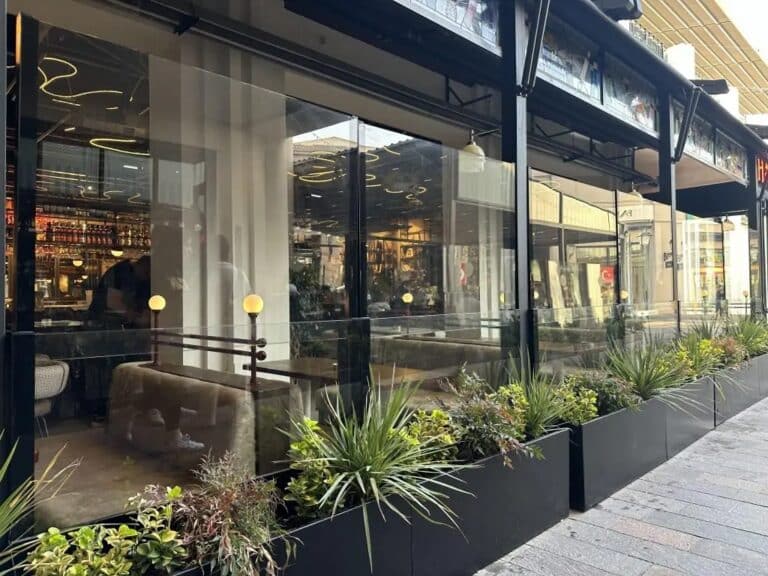
A windbreak glass structure with a wheeled planter offers the protection of a fixed barrier without the need for a permanent structure. Thanks to the braked wheels located under the body, the unit can be positioned by pushing it with the help of a single person, and can be completely lifted when necessary. This flexibility is a decisive advantage for businesses that use their space for different purposes throughout the day. The carrier body uses... Aluminum alloy provides both lightness and long-lasting durability..
Why a Windbreaker Glass with Wheeled Planter?
Dividing an outdoor space with a fixed line isn't right for every business. A venue that sets up a large dining area at lunchtime and clears the space for live music in the evening cannot achieve this transition with a fixed barrier. Wheeled units make it possible to re-establish the layout in five to ten minutes.
The second reason is legislation. Businesses with permits to use sidewalks may be asked to vacate the area during municipal inspections. A system that is not fixed to the ground and can be easily moved will not cause a problem in this case. In rented premises, the fact that the system is portable in case of eviction means protecting the investment.
Wheel Structure and Brake Mechanism
The diameter and material of the wheel used directly determine the comfort of use. Small-diameter hard plastic wheels will snag on tile and parquet floors and make noise. Wheels with a diameter of at least 75 millimeters, polyurethane coating, and ball bearings should be preferred. These types of wheels do not scratch the floor and comfortably carry a loaded vehicle.
The braking mechanism must be two-stage: the first stage locks the wheel rotation, and the second stage locks the axis of rotation. In simple brakes that only lock the rotation, the unit rotates on its own axis in the wind, and the alignment of the track is disrupted.

Windbreaker with Wheeled Planter, Glass and Weight Balance
In a movable unit, weight is a paradoxical variable affecting both portability and resistance to tipping. A trunk that is too light is not safe in the wind; a trunk that is too heavy cannot be moved. Practical balance is established by filling the pot to approximately two-thirds of its volume. Using a lightweight potting mix and perlite instead of soil allows for weight management without compromising plant health.
In models with increased height, the center of gravity rises. In this case, an additional ballast plate is added to the base of the hull. In areas with constant winds, such as coastlines, it is more appropriate to switch to a fixed anchored solution instead of a movable model.
Which businesses is it suitable for?

Daily Use Practices
When pushing the unit, force should be applied to the top edge of the housing, not the glass panel. Lateral force applied to the glass will create gaps in the seal housing over time. When assembling the line, units should be placed one behind the other, not side-by-side; this reduces the surface area exposed to the wind.
All brakes must be ensured to be locked at the end of the evening shift. On inclined surfaces, a single open brake can cause the line to be completely derailed by morning. In busy areas, maintaining a minimum service gap of 90 centimeters between units is required for both personnel and regulatory reasons.
Windbreaker with Wheeled Planter - Glass Care
For wheeled models, the focus of maintenance is on the wheels. Once a month, the threads, hair, and leaves tangled around the wheels should be cleaned, and the bearing housings should be lubricated with a thin layer of oil. At the end of the season, the brakes should be left engaged during storage; brake pads that remain locked for extended periods will stick. Body and windscreen maintenance is the same as for other models: a damp cloth and standard windscreen cleaner are sufficient.
Wheel Selection According to Terrain Type
The performance of movable units largely depends on their compatibility with the floor. All types of wheels operate smoothly on even screed and epoxy floors. However, on surfaces with joints, such as tile and cobblestone, small-diameter wheels will get stuck in the joints and the unit will not move; wheels with a diameter of at least 100 millimeters should be used on these surfaces.
On wooden decks, hard wheels leave marks on the wood. Wide-surface wheels coated with polyurethane or thermoplastic eliminate this problem. On grass and soil surfaces, wheeled models are generally unsuitable; fixed frames with wide footplates should be preferred in these areas.
There is another important point to consider with sloping terraces. For slopes exceeding two percent, braked wheels alone are insufficient; additional chocks or adjustable support legs must be used. Determining this detail during the project phase will prevent additional costs later.
Comparison with Fixed Models
Fixed models offer higher wind resistance and a slimmer appearance; mobile models provide flexibility. In most projects, the most efficient solution is to use both together: the main facade facing the prevailing wind direction is fixed, while the side facades are installed on wheels. You can review the relevant system pages: windbreak glass systems, windbreak glass systems.
You can review the relevant system page: Cafe, restaurant and hotel garden enclosure systems. To share your measurements and receive modulation suggestions: communication.
Brief Assessment
Wheeled windbreak glass with planter attachments is a flexible solution designed for businesses whose layout changes throughout the day. With braked wheels, the correct wheel diameter, and sufficient frame weight, both ease of movement and wind protection are ensured.
The answer to whether a windbreak glass unit with wheeled planters or a fixed unit is more suitable for your space depends on how often you rearrange your outdoor area. If the layout changes frequently, windbreak glass units with wheeled planters significantly simplify operation.


 Türkçe
 English
 Français
 Deutsch
 العربية
 Español
 فارسی
فارسی Afrikaans
 Italiano
 日本語
日本語 Bahasa Indonesia
 简体中文
简体中文 Українська
 Svenska
 Shqip
Shqip Русский
 Português
 Română
 한국어
한국어 Azərbaycan dili
 Polski
 Български
 Српски језик