
Once you've decided to cover an area with glass, the second question arises: should the covering be fixed or movable? The choice between a retractable glass roof and a fixed glass roof is not just a matter of budget; how the space will be used determines this decision.
Strengths of Fixed Glass Roofs
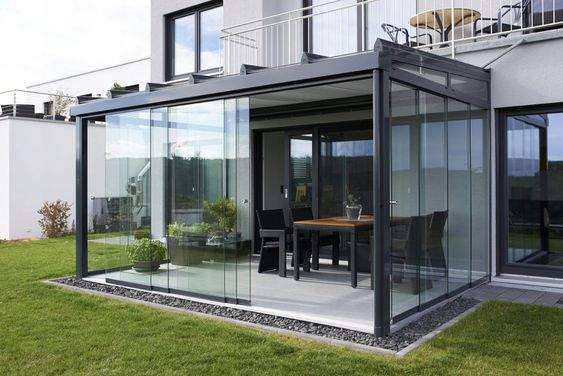
The fixed solution is the simplest and most durable option. Because there are no moving parts, motors, or rails, the risk of failure is virtually nonexistent. The seal is fixed once and for all. The initial investment cost is low, and maintenance is limited to glass cleaning.
In contrast, a fixed glass roof transforms the space beneath it into an enclosed area. This creates a greenhouse effect in the summer months, requiring mechanical ventilation or air conditioning. Natural air circulation is only possible through openings in the side facades.
What difference does a retractable glass roof make?
The main value of an openable ceiling is ventilation. Hot air rises; when an opening is created in the ceiling, this air escapes and cool air is drawn in from the sides. This natural circulation, known as the chimney effect, significantly reduces the perceived temperature on summer afternoons..
The second difference is psychological. When the panels are opened, the space transforms into an outdoor environment; the sky is visible, and airflow is felt. The ability to use the same space indoors for part of the year and outdoors for another part directly impacts customer experience, especially in businesses.

Cost Comparison of Retractable Glass Roof and Fixed Roof
A mobile system requires a higher budget than a fixed solution due to the components such as rails, carriages, motors, controls, and sensors. However, the comparison shouldn't be based solely on the initial investment. Under a fixed roof, using air conditioning or fans in the summer creates a continuous operating expense. With a mobile system, this expense is largely eliminated.
Maintenance Burden
In a stationary system, maintenance is virtually nonexistent. However, in a moving system, the rails, carriages, seals, and motor require regular inspection. Simple maintenance twice a year is sufficient, but if this discipline is not maintained, movement becomes difficult and the motor is strained.
Hybrid Solution: Combining the Two
In many projects, the most sensible approach is to make part of the roof fixed and part movable. Service and passage areas are covered with fixed glass; the seating area is designed with openable panels. In this way, costs are kept under control while ventilation and the feeling of an open space are preserved.

Openable Glass Roof and Comfortable Lighting
Both solutions provide natural light, but the quality of the light differs. Under a fixed roof, the light intensity remains constant throughout the day; this excess can be bothersome in summer. With movable panels, however, the amount of light can be adjusted by changing the opening angle. This flexibility is a significant advantage on south and west-facing facades that receive direct sunlight.
Behavior of a Retractable Glass Roof in Rain and Snow
In a closed position, both solutions behave in the same way: water flowing along the slope is directed into the gutter. However, in terms of snow load, a fixed roof is safer because there is no track clearance or movable connection points. If a movable system is chosen for regions with high snow loads, the profile cross-section and slope should be increased accordingly.
Adapting to the Existing Structure
One issue often overlooked during the decision-making process is how the roof will be attached to the existing building. A fixed glass roof is secured to the facade with a single line, and the load distribution is simple. A movable system, however, requires a more rigid connection along the rail line; if the facade cannot support this load, additional supporting columns become necessary.
The second consideration is height. Because the movable panels overlap in the open position, a certain package thickness is created. If there are windows, balconies, or facade cladding on the upper floor, this should not obstruct the front of the package. There is no such restriction in a fixed solution.
The third issue is appearance. Fixed roofs can be achieved with thinner profile lines and appear more subdued architecturally. In movable systems, the rail and frame profiles are inevitably more prominent. This distinction can be decisive in historical structures or delicate facades.
Three Questions to Ask When Making a Decision
First: will I be using this space during the summer months as well? Second: will I be using heating or cooling? Third: can I have maintenance done twice a year? The answers to these three questions almost single-handedly determine the right solution.
Browse the products.
You can review the relevant system pages: automatic glass roof system, Bioclimatic aluminum folding roof systems. You can review the relevant system page: winter garden systems. To share your measurements and receive modulation suggestions: communication.
Brief Assessment
The choice between a retractable glass roof and a fixed glass roof is resolved by three questions: will the space be used in the summer, will it be heated, and can it be maintained twice a year? Once the answers are clear, the right solution becomes apparent.



 Türkçe
 English
 Français
 Deutsch
 العربية
 Español
 فارسی
فارسی Afrikaans
 Italiano
 日本語
日本語 Bahasa Indonesia
 简体中文
简体中文 Українська
 Svenska
 Shqip
Shqip Русский
 Português
 Română
 한국어
한국어 Azərbaycan dili
 Polski
 Български
 Српски језик