
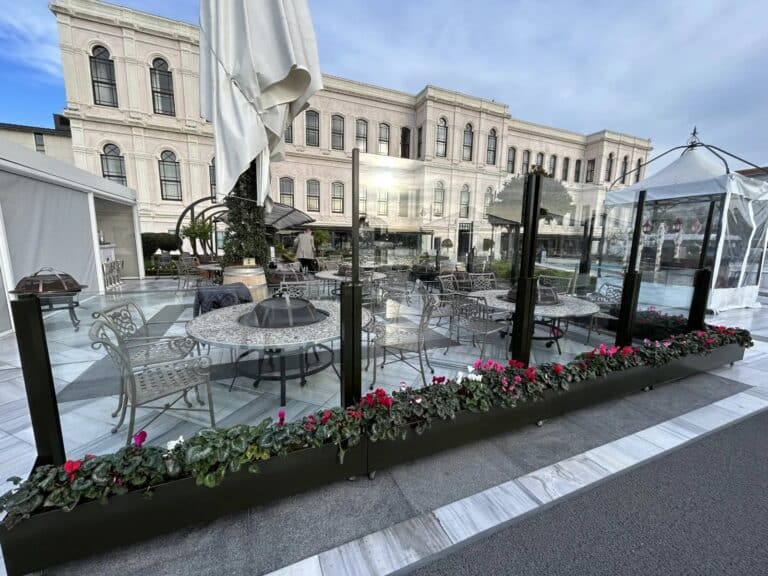
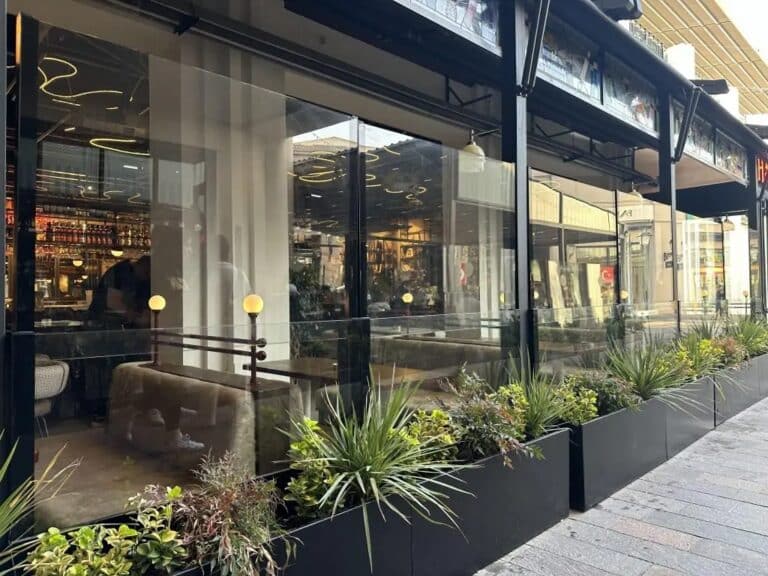
Manual windbreak glass is a completely hand-operated glass barrier solution that does not involve any auxiliary mechanisms such as electricity, motors, or pistons. Due to its simplicity, it has the lowest risk of failure and the lowest maintenance costs. It is the first option to consider in projects with limited budgets or inadequate infrastructure.
What Is a Manual Glass Windbreak?
The system consists of aluminum carrier profiles and It consists of tempered glass panels.. The panels are either permanently mounted to the frame or can be opened manually using a simple hinge and latch mechanism. The only power source for movement is the user themselves. Therefore, components such as cables, transformers, sensors, and controls are completely eliminated.
Why is it still preferred?
In an era of widespread automation, there are concrete reasons to prefer manual solutions. First, there is cost: for the same meterage, a manual system is significantly cheaper than a motorized alternative. Second, there is reliability; since there is no mechanism to malfunction, the system does not become inoperable in the middle of the season.
The third reason is infrastructure. Motorized systems cannot be implemented in businesses located within historical areas, in rented spaces, or in areas where it is not possible to have electricity. The fourth reason is frequency of use: if the barrier will remain closed throughout the season, there is no point in paying for mobility.
Manual Windbreak Glass Structure and Material
Carrier profile
Electrostatic powder-coated aluminum is used. The thickness is determined according to the panel height and wind load. Thinner panels are not noticeable at first glance, but after a few seasons, they will manifest as stretching in the profile.
Pine
8 mm or 10 mm tempered glass is standard. Tempered glass is mandatory in areas with high pedestrian traffic; it does not create sharp pieces if it breaks.
Connection and seal
The screws must be made of stainless steel. The gasket prevents direct contact between the glass and the metal and tolerates thermal expansion.

Fixed and Mobile Manual Models
Manual solutions are divided into two categories. In fixed models, the panel is permanently mounted to the frame; it provides maximum wind resistance and requires no maintenance. In movable models, the panel is hinged, opened manually, and locked with a latch. In the movable model, the open panel must be locked; otherwise, the wind will slam the panel shut.
Who is it suitable for?

Limitations
The limitations of the manual system become apparent as the need for movement increases. Manual operation becomes burdensome for personnel when a barrier needs to be opened and closed several times a day. Furthermore, large panels are not suitable for manual handling; safe operation by a single person becomes difficult with panels over 120 centimeters.
The second limitation is the inability to respond automatically. In the event of a sudden storm, shutting down the panels depends on human intervention. This can pose a risk during off-peak hours; therefore, manual systems should be planned to remain in the off position.
Manual Windbreak Glass Cost Items
In a manual line, the items determining the budget are simple: total linear meters, profile cross-section, glass thickness, surface treatment, and installation. There are no items for motors, sensors, control systems, or electrical infrastructure. Therefore, a manual solution for the same area can be installed with a significantly lower budget than an automated solution, and the business can expand the line with movable modules in the coming years if needed.
Is it possible to switch to automatic later?
A frequently asked question is whether a manual production line can be automated in the future. The answer depends on the profile system initially chosen. In lines constructed with profiles that have a motor mount and a suitable body cross-section, it is possible to add mechanisms later. However, with economical profiles with closed cross-sections, conversion is not practical.
Therefore, while the budget currently allows for a manual solution, if automation is planned for the future, this should be specified during the project phase. When profile selection is made accordingly, future conversions will be limited only to the cost of the mechanism.
Another phased approach is to automate only the critical section of the line, not the entire line. For example, the two modules where the service transition occurs could be motorized, while the rest of the line could be set up manually. This hybrid setup offers a balanced middle ground between convenience and budget.
Care
Maintenance on stationary manual lines consists of glass cleaning and annual bolt tightening checks. On movable models, hinge lubrication and latch checks are added. In coastal areas, annual rinsing with fresh water is the most effective way to extend paint life.
For the Right Edit
The answer to the question of whether to choose manual or automatic depends on the usage routine of the area. If the barrier will remain in the same position throughout the season, a manual solution is both economical and durable. You can review the relevant system pages: windbreak glass systems, windbreak glass systems, automatic terrace enclosure systems. To share your measurements and receive modulation suggestions: communication.
Brief Assessment
Manual windbreak glass is the solution with the lowest risk of failure because it contains no moving parts or electricity. If the barrier is to remain in the same position throughout the season, manual windbreak glass is both an economical and durable choice.



 Türkçe
 English
 Français
 Deutsch
 العربية
 Español
 فارسی
فارسی Afrikaans
 Italiano
 日本語
日本語 Bahasa Indonesia
 简体中文
简体中文 Українська
 Svenska
 Shqip
Shqip Русский
 Português
 Română
 한국어
한국어 Azərbaycan dili
 Polski
 Български
 Српски језик