
When choosing between facade closing systems, both technical specifications and how daily use will be implemented are important. The advantages of guillotine glass doors mostly lie in their use of space and the view they offer. This article examines the advantages one by one and makes an honest comparison with alternative systems.
Advantages of Guillotine Glass: Space Saving
This is the most significant advantage. Because the panels move vertically, no bulges form on the sides when the panels are open. In folding systems, the panels that are gathered permanently cover a section of the facade; in sliding systems, the opening is at most half the length of the facade. In the vertically moving solution, an uninterrupted opening is achieved along the entire length of the facade.
Landscape and Visual Lightness
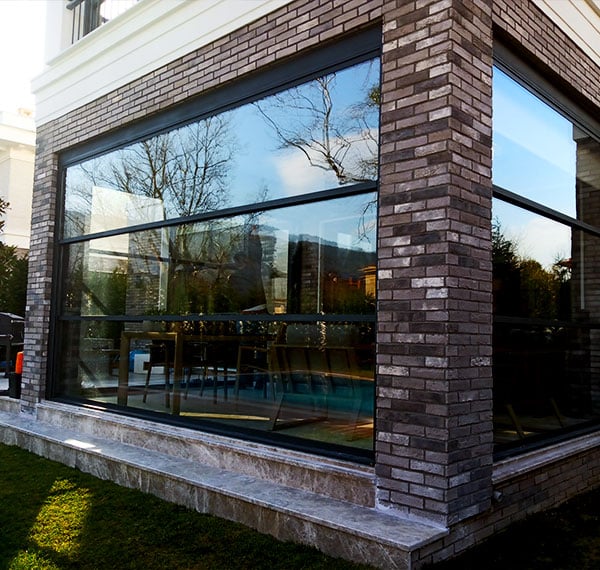
When closed, the only things visible are the thin side columns and the panel joint line. By keeping the number of horizontal sections to a minimum, the facade is perceived almost as a single glass surface. In spaces with sea, lake, or city views, this visual lightness is directly reflected in the customer experience.
Advantages of Guillotine Glass: Gradual Ventilation
Since the panel can be stopped at the desired height, the amount of ventilation can be adjusted steplessly. Opening only the lower section by fifteen centimeters provides air circulation without creating drafts. Folding systems do not have this intermediate step; either one panel opens completely or remains closed.

Insulation Performance
When using double-glazed panels, the system allows the space to be used even during winter months. Seals in the side guides and gaskets between the panels prevent air leakage. Insulation While not as performant as a full-fledged window frame, it provides one of the best possible results in an openable facade.
Ease of Use
In motorized models, multiple facades are managed simultaneously with a single remote control. Personnel control the entire facade with a single operation at morning opening and evening closing. In folding systems, each panel needs to be opened and locked individually, which results in significant time loss on large facades.
A Brief Assessment Instead of a Comparison Table

We also need to talk about the disadvantages.
Every system has its limitations. In a vertically movable solution, sufficient ceiling height is essential because the panels overlap at the top. In spaces with low ceilings, the number of panels is increased, which increases the number of profile lines and compromises somewhat on visual simplicity.
The second limitation is maintenance. Ropes, pulleys, and counterweights are moving parts and require regular inspection. In a system where maintenance is neglected, panel movement becomes difficult. In contrast, there is no such burden in fixed window frames.
The third constraint is the initial investment cost. Due to the mechanism and in-column hardware, the system requires a higher budget than a simple sliding solution of the same size.
In what situations do the advantages of guillotine glass become more apparent?
If a full opening of the facade is desired, and there is no space for a package on the side walls, and the view is a priority, a vertically movable system is the most appropriate choice. In projects where budget is a determining factor and only partial opening of the facade is sufficient, sliding or folding solutions remain reasonable.
The Practical Benefits of Guillotine Glass for Businesses
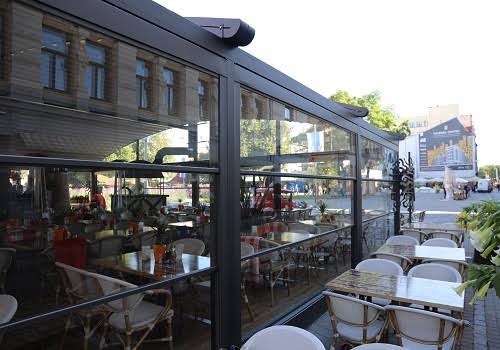
In commercial use, the value of a facade system is measured by how many extra tables it makes usable. A multi-stage opening facade is one of the best solutions for providing this flexibility, as it can be adjusted multiple times throughout the day according to weather conditions. It allows for use as a closed facade during the cool morning hours, a semi-open one during the midday heat, and a fully open one in the evening.
The second practical benefit is cleaning. Wiping is quick because the panel surfaces are flat and easily accessible. In folding systems, the spaces between the panels, which are bundled together, are difficult to clean, and dust accumulation becomes visible over time.
The third benefit is security. When the facade is completely closed and locked at closing time in the evening, the space becomes a glazed but enclosed area. Furthermore, basic protection is provided without the need for shutters or additional security features.
Combined Use
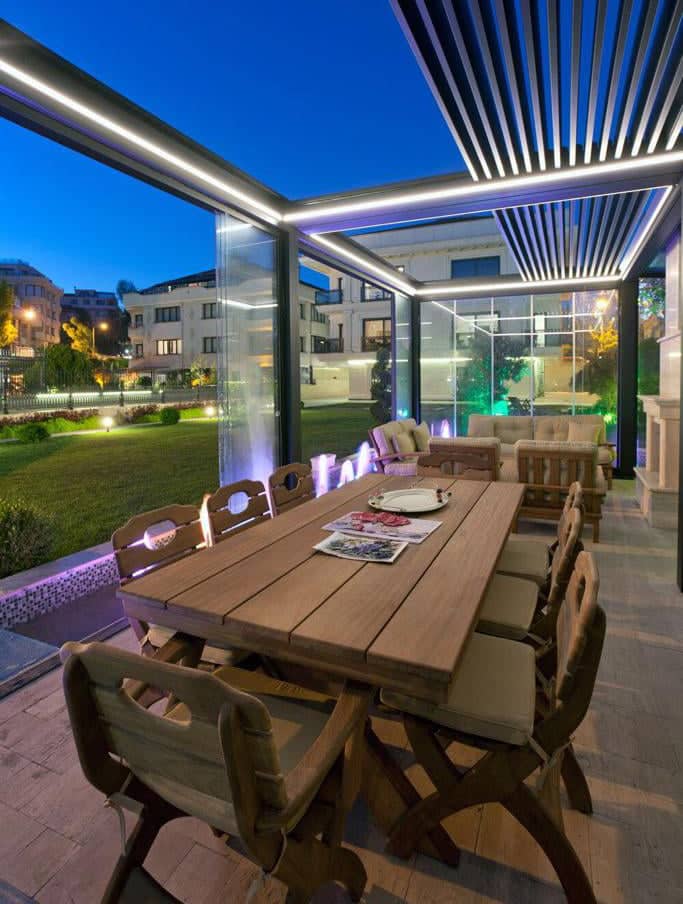
In many projects, the best results are achieved by using systems together. The main facade can be solved with vertically movable panels, and the side facades with a folding system. You can review the relevant system pages: automatic pergola awning systems, automatic glass roof system.
Before the Decision
Facade dimensions, ceiling height, frequency of use, and budget should be considered together. You can review the relevant system pages: automatic guillotine glass balcony systems, folding glass balcony systems. To share your measurements and receive modulation suggestions: communication.
Brief Assessment
The advantages of guillotine glass systems are most evident in terms of space saving, views, and stepped ventilation. The ability to fully open the facade, if ceiling height and budget permit, is a key feature that distinguishes this system from other solutions.




 Türkçe
 English
 Français
 Deutsch
 العربية
 Español
 فارسی
فارسی Afrikaans
 Italiano
 日本語
日本語 Bahasa Indonesia
 简体中文
简体中文 Українська
 Svenska
 Shqip
Shqip Русский
 Português
 Română
 한국어
한국어 Azərbaycan dili
 Polski
 Български
 Српски језик